
In-centre therapy support
Our clinicians come into your centre, spend time with your team and your children, and give you a written report with strategies you can act on.
Understanding your setting before suggesting anything
Most therapy happens in a clinic room, one child at a time. This is different. Our clinicians come into your centre or school, spend time in your rooms, and talk with the people who know the children best: your educators and centre managers.
What you receive is a written report: the context your team gave us, what our clinicians observed, and a set of strategies drawn from both. Not generic advice, but suggestions grounded in your actual rooms, routines and children.
We work with your team rather than around them. Your educators know these children, these spaces and these routines. Our role is to add another perspective, not to take over.
Not sure where to start?
Most partnerships begin with a conversation about what your team is noticing. There's no minimum commitment and no obligation. We'll talk through what would genuinely help before anything is arranged.
Start a Conversation →How an in-centre review works
A clear sequence, so your team knows what to expect at every stage and when the report will land.
Gathering context
We start by talking with your centre managers and educators. What are you seeing? What's already working? What's been difficult? Your team's knowledge shapes everything that follows.
Observation in the rooms
Our clinicians spend time in your spaces during ordinary routines, not in a separate room, and not in a way that singles any child out.
Your written report
We bring the context and the observations together into a report, with strategies drawn from both. Something your team can keep, share and refer back to.
Putting it into practice
Some strategies can be used straight away. Others may need a workshop, resources or further support, and we'll be clear about which is which.
What's in your report
Three sections, each building on the last. Written in plain language so it's useful to your whole team, not just your leadership.
Context
What your centre managers and educators told us about the setting, the children, the routines, and the things your team has already tried.
Observations
What our clinicians noticed during their time in your rooms, described plainly, without labelling individual children or making diagnostic claims.
Strategies
Practical suggestions drawn from the context and the observations together, with a clear sense of what your team can act on now and what may need more support.
Where strategies can lead
Not every suggestion can be picked up straight away. Where something needs more than a conversation, these are the usual routes.
Direct Implementation
Many strategies are things your educators can start using immediately, like adjustments to routines, the layout of a room, or how an activity is set up.
Educator Workshops
Where a strategy needs deeper understanding across your team, a session with our clinicians can build the knowledge behind it.
Parent Sessions
Some strategies work best when families are doing something similar at home. A parent workshop brings your community into the conversation.
Resources & Equipment
Occasionally a strategy needs a specific tool or resource. We'll say what it is and why, and you decide whether it's worth it.
Working with MercyCare
Therapy for Kids Perth works with MercyCare Early Learning to bring speech pathology and occupational therapy into their centres. Our clinicians work alongside MercyCare educators, sharing insights into child development and suggesting adjustments that support participation and inclusion.
It's a whole-of-environment approach rather than individual therapy sessions. The focus is on building what educators can do every day, in every room.
Read more about our partnership with MercyCare →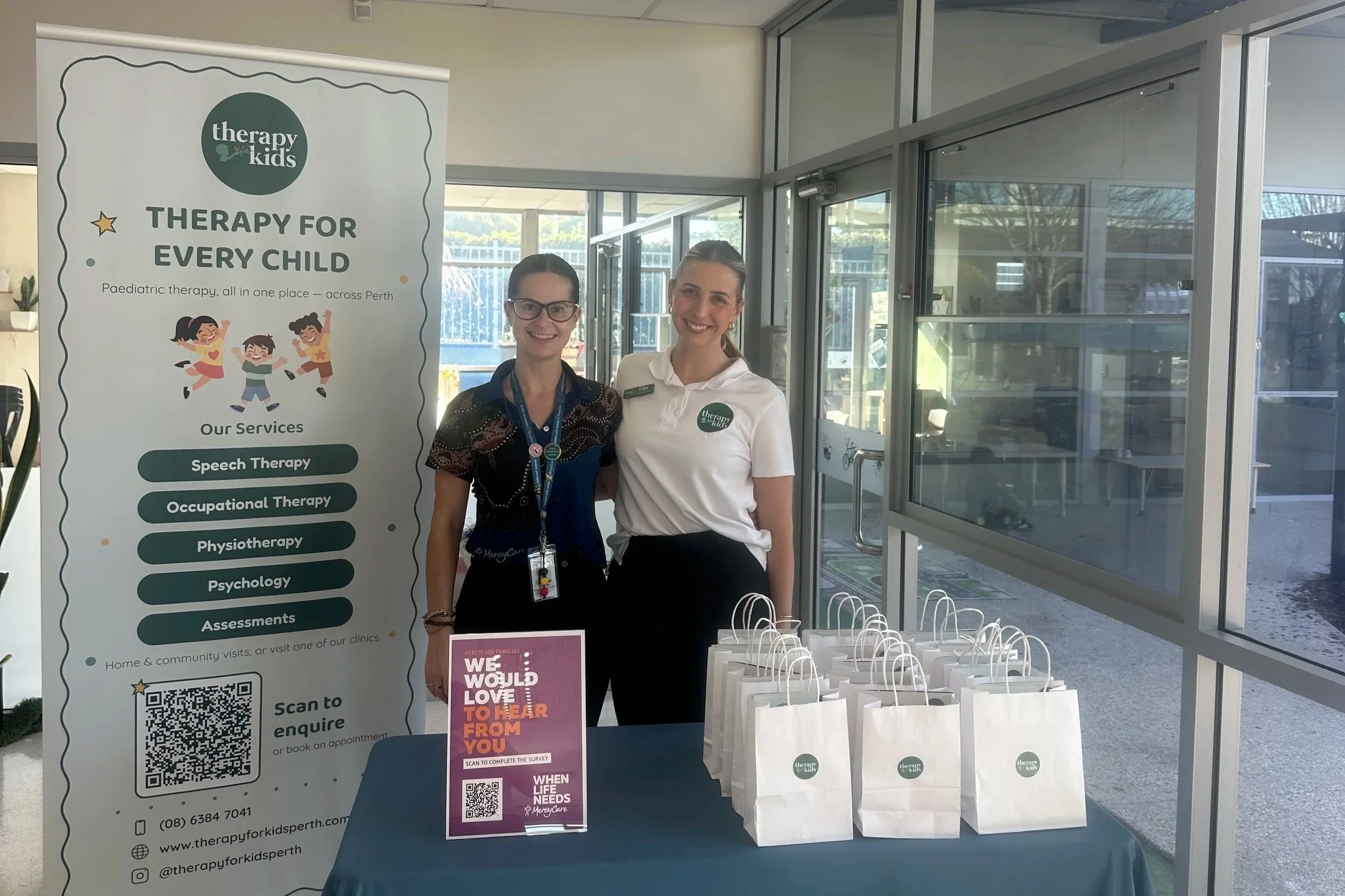
 Early Learning Partner
What's included, and what isn't
Being clear about the boundaries of the programme helps everyone: your team, your families, and us.
Included
Time with your leadership and educators, observation in your rooms, and a written report covering context, observations and strategies.
Not included
The programme doesn't include individual assessments, diagnosis, or one-to-one therapy. Reports describe the environment and general patterns rather than individual children.
Arranged separately
Families who'd like individual support arrange it with us directly. Those services are booked, funded and managed separately, and anything about a specific child stays between our team and that family.
What does it cost?
Every centre is different, so pricing depends on your setting, including the number of rooms, how many visits are involved, and what your team would like the review to focus on. Get in touch and we'll talk through your centre's needs and put together a quote that fits.
Are you a parent or carer? If your child attends a centre we work with, our visits support the whole room rather than any individual child. If you'd like individual support, enquire with our team. No referral is needed for most funding types.